Furniture materials and construction
Inside Cisco Home Furniture: Frames, Upholstery, and Material Choices
A sofa’s first impression may be all silhouette: a narrow arm, a deep seat, a beautifully tailored slipcover. Its lasting character, however, is shaped by what lies beneath. Frame, support system, cushion fill, and upholstery work together to determine how a sofa feels, how it ages, and how naturally it fits into daily life. Here is how to read those details when considering Cisco Home furniture, with a closer look at the material choices behind comfort and durability.
The quiet architecture beneath a sofa
Furniture construction is an exercise in balance. A sofa must be inviting without feeling unstable, supportive without feeling rigid, and visually composed while accommodating the unceremonious rhythms of home: a long evening, an impromptu guest, a pet claiming the best seat. The frame carries the structure; the suspension distributes weight; cushions create the immediate sensation of comfort; and upholstery protects the whole while giving it color, texture, and presence.
These elements are not interchangeable. A generous cushion cannot compensate indefinitely for a weak foundation, just as a handsome hardwood frame does not guarantee that a seat will suit every body or preference. Evaluating furniture construction means looking at the relationship between components—and asking practical questions about how they are made, what maintenance they need, and whether the design suits the room it will inhabit.
Cisco Home’s listed sofas offer useful examples of different design approaches. The Cisco Home Elm Sofa has a bench seat and three back cushions on a relatively compact frame. The Rebecca Deluxe Sofa pairs two seat cushions with feather-cloud fill around a foam core. The Dexter Sofa presents a more contemporary profile, with a visible walnut wood base. These details describe distinct experiences, not a universal hierarchy: the right one depends on how you sit, how you live, and what you want a sofa to contribute to a room.
Frames: the foundation of furniture durability
The frame is the sofa’s structural skeleton. It supports the seat and back, anchors the arms, and helps keep the piece square through repeated use. Hardwood is commonly used in upholstered furniture because it can provide a robust foundation when properly selected, joined, and assembled. But “hardwood frame” alone is not a complete measure of quality. Construction details matter: how the parts connect, how the corners are reinforced, and whether the frame is designed for the expected loads all influence long-term performance.
Product descriptions for the Elm, Rebecca Deluxe, and Dexter identify FSC-certified hardwood in their frames; the Rebecca description specifies maple hardwood. FSC certification relates to the sourcing of forest products under the Forest Stewardship Council’s standards. It can help consumers understand a material’s sourcing credentials, but it should not be mistaken for a guarantee of a particular comfort level, construction method, or lifespan. For those considerations, ask for more specific information about joinery, reinforcement, and care.
Dimensions are another part of the frame story. The Elm is listed at 84 inches wide, 40 inches deep, and 32.5 inches high. The Rebecca Deluxe is also listed at 84 inches wide and 40 inches deep, with a 31-inch height. Numbers on a product page become more meaningful when measured against the room: doorways, stair turns, the path around a coffee table, and the distance between the sofa and television or conversation area. Measure the full delivery route, not just the space where the sofa will sit.
Also consider what the frame’s proportions imply for posture. A deeper sofa may invite reclining, while a more upright seat can make conversation and getting up easier. Arm height affects how the sofa relates to side tables and how comfortably a person can rest an arm. The Elm’s listed seat height is 18 inches; the Rebecca Deluxe’s is 20 inches. A difference of two inches can feel surprisingly significant, particularly for shorter users or anyone who prefers a firmer, easier-to-rise-from seat.
Removable legs can simplify transport and, depending on the design, help a sofa pass through a narrow doorway. They may also make it easier to clean beneath the furniture. Before ordering, confirm whether legs are removed for delivery, how they attach, and whether the finished sofa height changes when a slipcover or alternate leg configuration is selected.
Suspension: what supports the cushions
Between the frame and the seat cushion is a less visible but influential layer: the suspension system. It helps distribute a sitter’s weight and affects the way a seat yields, rebounds, and feels over time. Webbing is one type of support identified in the Elm and Dexter descriptions. The Rebecca Deluxe listing specifies soft-edge support. Those terms are useful starting points, but they do not, by themselves, describe every construction detail or predict an individual’s experience.
When assessing suspension, try to understand how it performs as part of the complete sofa. Does the seat feel evenly supported from the middle to the edges? Does it give way more than you prefer? Is the front edge comfortable against the back of your legs? If possible, sit in the sofa for more than a brief showroom pause: change positions, lean back, and sit where another person would normally sit. Notice whether the support feels consistent across the seat.
Suspension and cushion fill should be considered together. A soft cushion on a responsive foundation may feel different from the same cushion placed over a firmer support system. This is one reason specifications are informative but not a substitute for testing—or for asking a retailer to explain how a particular configuration is expected to feel.
Cushioning, from buoyant support to feather-soft ease
Seat cushions determine much of a sofa’s immediate personality. Their feel depends on the materials inside, their layering, their shape, and the way they interact with the suspension. Broadly, some fills emphasize spring and shape retention; others prioritize a softer, more relaxed sensation. Many cushions combine materials to balance those qualities rather than relying on one fill alone.
The Rebecca Deluxe description gives one example: feather-cloud fill around a foam core. The foam contributes a supportive center, while the feather component is associated with a softer surface feel. This kind of layered construction may appeal to people who like a cushioned, lounge-friendly seat. It can also call for regular attention: cushions with softer or more mobile fill may benefit from plumping and rotating, depending on the manufacturer’s care guidance and the cushion design.
The Elm is described with a bench seat and three separate back cushions. A continuous bench cushion creates a clean, uninterrupted seat line and avoids seams between individual seat cushions. It may also make it easier to stretch out across the sofa. The trade-off is practical: the cushion is a larger piece to handle, and a single central sitting area may show use differently from a seat divided into two cushions. Its three back cushions offer separate areas of support and can be adjusted according to preference.
The Dexter has two seat cushions and two back cushions. Divided seats can make it easier to reposition one cushion at a time, and they establish a more segmented look. They also create visible seams that contribute to the design. Neither a bench seat nor separate cushions are inherently better. Think about the number of people who usually share the sofa, whether anyone likes to lie across it, and how much cushion adjustment you are willing to do.
For any cushion, ask what the manufacturer recommends for rotation, flipping, and routine care. Some cushions are reversible; others have a designated top or are shaped for a specific position. A cushion’s cover may zip off without being suitable for home laundering, so check the cleaning label before treating removability as a promise of easy washing. The right maintenance routine is the one supported by the construction and care instructions—not a general assumption about all foam, feather, or fabric upholstery.
Where latex fits into the conversation
Latex cushioning is valued for its resilience: it tends to respond to pressure and recover its shape rather than remaining compressed in the same way as some softer fills. For sofa shoppers, that can make latex an appealing material to investigate when seeking a buoyant, supportive seat. Yet the word “latex” is not a complete cushion specification. The composition, density, firmness, thickness, and any surrounding layers all influence the result.
It is also important to distinguish natural latex from synthetic latex and blends. The source and manufacturing process can differ, so a materials claim should be specific. Ask whether the latex is used throughout the cushion or as one layer within a mixed construction, and whether the product documentation identifies its type. If allergies are a concern, discuss the material with the manufacturer and a qualified healthcare professional rather than assuming that any one label resolves the question.
Latex is not identified in the supplied construction details for the Elm, Rebecca Deluxe, or Dexter sofas. Their descriptions name other specific features, including foam-core and feather-cloud fill for the Rebecca Deluxe, but do not establish latex as a cushion component. Therefore, shoppers interested in latex should verify the exact specification for the model and configuration under consideration. Materials can vary by option, and a general impression about a brand should never replace confirmation of the individual build.
When comparing latex with other cushion materials, focus on the experience you want rather than treating a material name as a verdict. Consider whether you prefer an elastic, buoyant response or a softer, more enveloping sit; how much cushion maintenance feels reasonable; and whether the manufacturer offers detailed care instructions. In-store testing can help, but it is most useful when paired with precise information about what is inside the cushion.
Upholstery: texture, performance, and personality
Upholstery gives a sofa its visual vocabulary. A textured weave can make a simple silhouette feel tactile and relaxed; a smooth fabric can sharpen the lines; a slipcover can lend the room a more casual, changeable quality. But fabric is more than a finishing gesture. Fiber content, weave, color, and care instructions all affect how a sofa behaves in everyday use.
Start with how the room functions. A frequently used family-room sofa may need a fabric that tolerates regular contact and can be maintained according to clear instructions. A formal sitting room may allow for a more delicate textile. Consider sunlight, pets, children, food and drink, and whether the sofa is likely to host overnight guests. Ask for a fabric sample when available, then look at it in the room’s light. A color that appears calm in a showroom can read warmer, cooler, brighter, or darker at home.
Customizable upholstery expands the possibilities but makes the choice more consequential. The listed Elm, Rebecca Deluxe, and Dexter models offer fabric customization. Before settling on a selection, request the fabric’s composition and cleaning code, and ask how it is expected to wear. A textile’s visual appeal matters, but so do its maintenance requirements and suitability for the household’s routine.
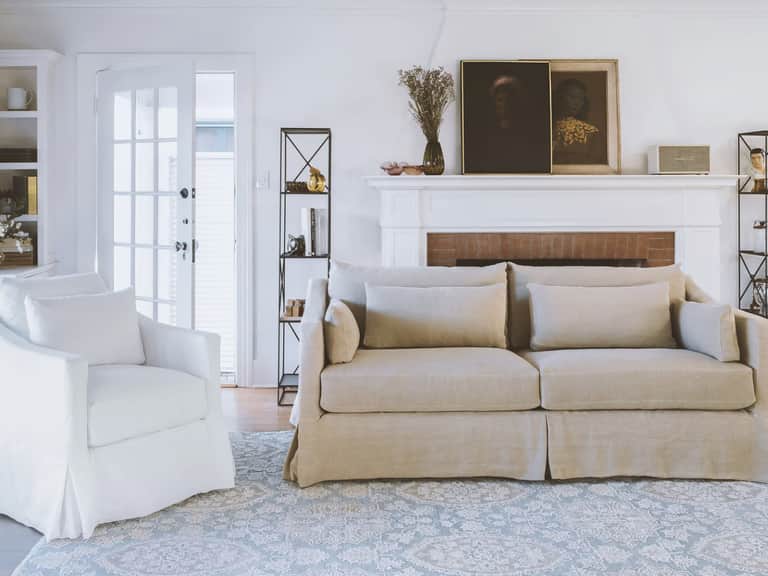
The Elm and Rebecca Deluxe descriptions also identify slipcover options. A slipcover changes both appearance and upkeep, while its fit and details shape the sofa’s overall impression. The Elm listing describes a two-inch slit skirt when slipcovered; the Rebecca Deluxe has a similar specified skirt detail. Ask whether a slipcover can be removed and cleaned, whether it is machine washable, and how it should be refitted. “Slipcovered” does not automatically mean washable: the fabric and care label are decisive.
Leather is a separate upholstery category with its own surface character and care considerations. It is not listed as an option for the Elm product description, so shoppers considering that model should confirm available selections directly. In every case, choose a material for the way it will be used as much as for the way it looks on a swatch.
Three silhouettes, three different approaches
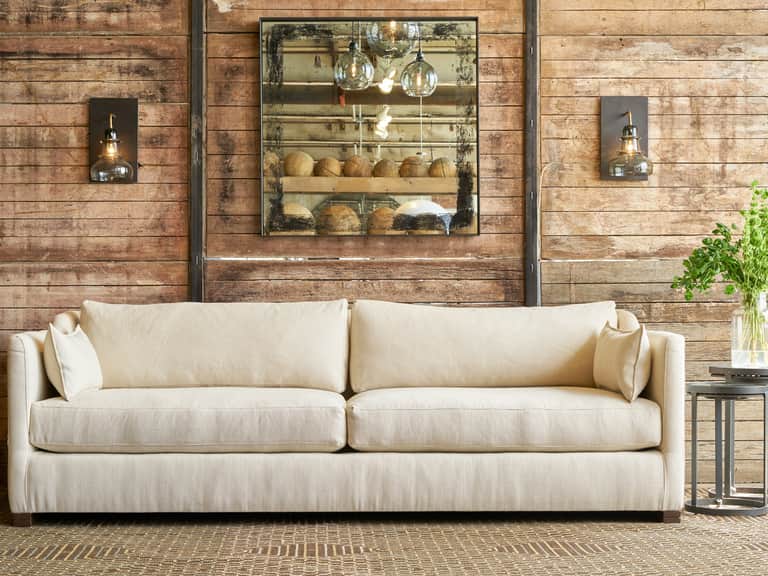
The Elm’s thin arms make a practical design statement: they preserve more of the sofa’s width for seating, an advantage in a room where every inch matters. Its bench seat, three back cushions, removable legs, and optional slipcover offer a combination of clean lines and flexible styling. At 84 inches wide, it is not a petite loveseat, but its relatively slender arms may help it feel less visually heavy than a sofa with broad, padded sides.
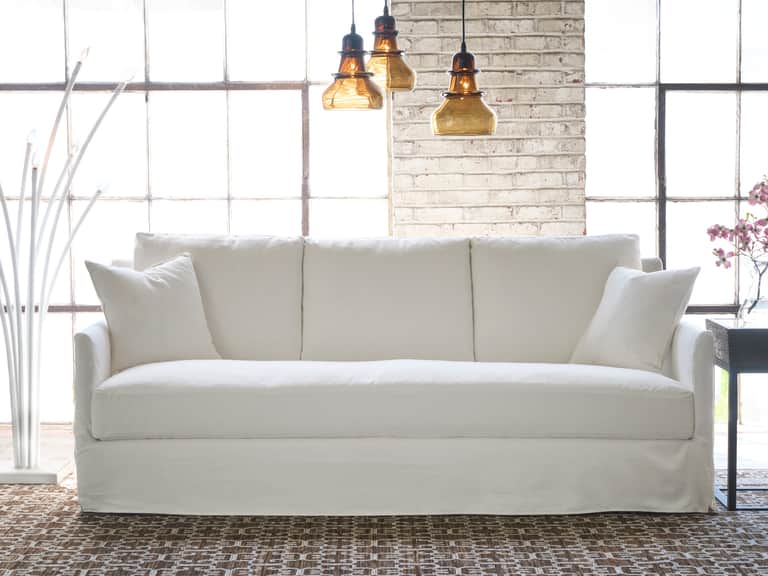
The Rebecca Deluxe takes a softer, more layered approach. Its two seat cushions, two back cushions, and four included accent pillows create a generous, composed arrangement. Feather-cloud fill around a foam core suggests a cushioned feel, while the listed hardwood frame and soft-edge support describe elements beneath that surface. A sleeper option is listed, so anyone considering it should check the exact mechanism, mattress details, and any effects on seating dimensions or comfort in the chosen configuration.
The Dexter makes its base part of the design. Its walnut wood base gives the sofa a more architectural outline and brings a visible material contrast to upholstered surfaces. The listed dimensions are 72 inches wide, 40 inches deep, and 29 inches high, and the description also references a 90-inch sofa and a 72-inch loveseat in the range. Confirm the precise size of the configuration being considered. The clean, exposed base may appeal to those who prefer a contemporary profile and a less skirted finish.
Comparisons are most useful when they connect features to habits. A household that likes to stretch out may appreciate a continuous seat; a room that calls for a tailored, grounded look may draw attention to the Dexter’s wood base; a preference for a pillowy arrangement may lead someone to examine the Rebecca Deluxe more closely. These are starting points, not guarantees. Sit, measure, and read the specifications for the exact version on offer.
A considered checklist before choosing
Furniture shopping becomes more assured when aesthetic instinct is supported by a few precise questions. Bring measurements, think about the room’s routines, and ask for details that connect materials to use. A polished product description is useful, but the goal is to understand the complete configuration—not just the silhouette.
- Frame: What wood and construction details are specified? How are the frame joints reinforced?
- Support: What suspension system is used, and how does it feel beneath the seat?
- Cushions: What are the exact fill materials? Are cushions reversible, and what upkeep is recommended?
- Latex: If latex is important, is it explicitly included in the selected cushion, and is its type identified?
- Fabric: What are the fiber content, care instructions, and expected maintenance requirements?
- Slipcover: Is it removable, and what does the care label permit? How does its fit affect the finished look?
- Fit: Do the overall dimensions, seat height, seat depth, and arm height suit both the room and the people who will use it?
- Delivery: Can the sofa fit through every doorway and turn? Are the legs removable for transit?
- Aftercare: What cleaning, cushion rotation, and repair guidance is provided?
It is worth asking for answers in writing when a particular material or configuration is essential. Specifications can vary between models and options, and details that sound similar may refer to different layers of construction. A clear description of the actual sofa protects against confusion and makes later care more straightforward.
Comfort is personal; construction is the context
There is no single cushion, frame, or upholstery choice that makes a sofa right for everyone. Comfort is shaped by body proportions, preferred posture, room temperature, use patterns, and personal taste. Construction details offer a language for comparing options, but they do not replace the experience of sitting down. A supportive seat may feel welcoming to one person and too firm to another; a soft, feathered surface may feel luxurious to one household and too maintenance-intensive for another.
That is why the most useful evaluation is both tactile and informed. Read the materials list, confirm the configuration, and test the sofa in a way that resembles ordinary use. Then consider the quieter parts of ownership: how the fabric will be cared for, whether cushions need regular plumping, whether the piece can be moved through the home, and whether the design still feels appropriate beyond a passing trend.
In the end, the appeal of a well-considered sofa lies in the relationship between its visible and hidden elements. A frame establishes the outline; suspension and cushions shape the sit; upholstery brings texture and character. When those choices are understood together, furniture becomes less of a leap of faith and more of a considered decision—one that can feel just as right on an ordinary afternoon as it did in the showroom.
Frequently asked questions
Does every Cisco Home sofa use latex cushioning?
No. Latex is not specified in the construction details provided for the Elm, Rebecca Deluxe, or Dexter models discussed here. Confirm the exact cushion materials for the model and configuration you are considering.
Is a bench cushion more durable than separate seat cushions?
Neither arrangement is automatically more durable. Durability depends on the cushion materials, construction, support beneath it, use, and care. A bench cushion offers a continuous seat surface, while divided cushions can be handled individually; ask about rotation and maintenance for the specific design.
What does FSC-certified hardwood tell a shopper?
It identifies a forest-sourcing certification associated with the wood. It does not, on its own, specify every detail of frame joinery, comfort, or expected service life, so it is best considered alongside construction information and the manufacturer’s care and warranty details.
Are sofa slipcovers always machine washable?
No. Removable covers may have specific cleaning requirements, and some should be professionally cleaned rather than machine washed. Check the care label and manufacturer instructions before cleaning or removing a cover.